The next time you join a Zoom call, make a WhatsApp voice call, dial into a Microsoft Teams meeting, or call emergency services from your mobile phone, you are using protocols that one man co-designed. Not protocols that were modified from something older. Not protocols that evolved gradually. Protocols that he and a small group of colleagues sat down and engineered from scratch, then persuaded the entire global telecommunications industry to adopt.
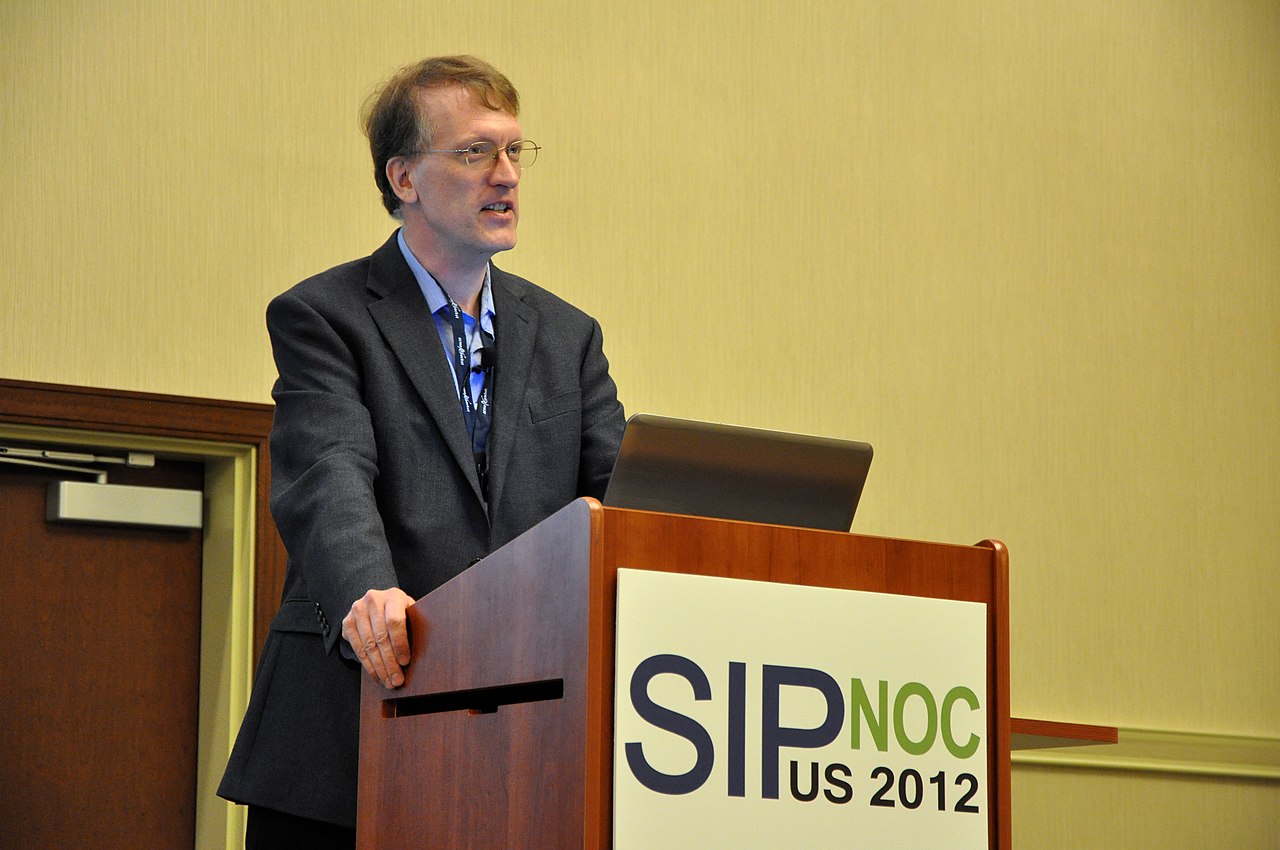
His name is Henning Schulzrinne. He is a professor at Columbia University. And the protocols he built — SIP, RTP, and RTSP — carry virtually every real-time voice and video call on the planet.
From Darmstadt to Bell Labs
Henning Schulzrinne was born on April 9, 1962, in Germany. He studied engineering management and electrical engineering at the Technische Universität Darmstadt, one of Germany’s premier technical universities. Then, as a Fulbright scholar, he crossed the Atlantic for his M.S.E.E. at the University of Cincinnati, followed by a Ph.D. in Electrical Engineering at the University of Massachusetts Amherst, completing it in 1992.
His first job out of graduate school was at AT&T Bell Laboratories — the legendary research institution that had already produced the transistor, Unix, C, and the laser. At Bell Labs, Schulzrinne began working on the problem that would define his career: how do you send voice and video over the internet in real time?
In the early 1990s, this was considered almost impossible at scale. The internet was designed for data — packets that could arrive out of order, get delayed, or be retransmitted without anyone noticing. Voice and video are the opposite: they need to arrive in order, on time, every time. A 200-millisecond delay in an email is invisible. A 200-millisecond delay in a phone call makes conversation impossible.

Three Protocols That Replaced the Phone Network
Schulzrinne didn’t solve one problem. He solved three, each with a dedicated protocol that became an Internet standard:
RTP (Real-time Transport Protocol) — co-authored with Stephen Casner, Ron Frederick, and Van Jacobson. RTP solves the fundamental problem of carrying audio and video over the internet: it timestamps every packet so the receiver can reassemble them in the correct order and play them back smoothly. Without RTP, internet voice calls would sound like someone talking through a blender. Every VoIP call, every video stream, every live broadcast on the internet uses RTP.
SIP (Session Initiation Protocol) — co-designed with Mark Handley, Eve Schooler, and Jonathan Rosenberg. SIP is the protocol that sets up, manages, and tears down voice and video calls. When you dial a number on Zoom or your office IP phone rings, SIP is doing the work. It replaced the century-old telephone signalling systems with an elegant, text-based protocol modelled after HTTP and email. Today, SIP is the backbone of virtually every enterprise phone system, every mobile carrier’s VoLTE infrastructure, and every NG-911 emergency calling system in the developed world.
RTSP (Real-Time Streaming Protocol) — the protocol that enables streaming media servers to control playback (play, pause, seek). While HTTP-based streaming has largely replaced RTSP for consumer video, RTSP remains critical in IP cameras, surveillance systems, and industrial video applications.

From Lab Protocols to Global Standard
What made Schulzrinne’s work extraordinary wasn’t just the technical elegance — it was the adoption. SIP and RTP didn’t remain academic curiosities. They became the global standard.
The 3GPP consortium (which defines mobile phone standards) adopted SIP as the signalling protocol for VoLTE — Voice over LTE. This means every 4G and 5G voice call in the world uses Schulzrinne’s protocol. CableLabs adopted SIP for cable telephony. NENA (the National Emergency Number Association) adopted SIP for next-generation 911 systems. When you call 911 from your smartphone and it routes to the nearest emergency centre, SIP is making that connection.
The economic impact is staggering. SIP-based VoIP didn’t just improve telephone service — it destroyed the traditional telephone industry’s business model. International calls that cost dollars per minute in the 1990s became essentially free. Enterprise phone systems that required proprietary hardware from Cisco or Avaya became software applications. An entire generation of communication startups — Skype, Vonage, WhatsApp, Zoom, Teams — was built on the foundation Schulzrinne helped lay.

Schulzrinne received the 2022 ACM SIGCOMM Award for Lifetime Achievement — one of the highest honours in computer networking — for “impactful and sustained contributions to the design of protocols, applications, and algorithms for Internet multimedia.”
Key Milestones

The Quiet Revolution in How Calls Are Made
It is hard, in 2026, to remember how strange SIP felt when it was new. For a century, placing a telephone call meant asking the phone network to build you a dedicated, end-to-end, time-division circuit between two specific endpoints, held open for the duration of the conversation, torn down when you hung up. Every component in that chain — the copper pair, the local switch, the trunk, the long-distance carrier, the terminating switch, the final local loop — was engineered around the assumption of circuit switching. Billing was built around circuit-minutes. Regulation was built around circuit-based tariffs. An entire global industry, worth hundreds of billions of dollars a year, existed to operate and maintain the circuit-switched telephone network.
Schulzrinne’s protocols said: throw all of that away. Voice is just another kind of data. Signalling is just another kind of text. Media streams are just another kind of IP packet. The call control plane and the media plane can be separated. The endpoints can be stupid or smart; the network does not care. Anyone can write a SIP client, anyone can run a SIP server, anyone can be a telephone company. And because the protocol is open and text-based — SIP messages look remarkably like HTTP requests — anyone can debug it with a packet capture and a text editor. No proprietary test equipment. No vendor lock-in. No priesthood.
The incumbent telephone companies initially dismissed SIP as an academic curiosity. They had a hundred years of switching expertise and a trillion dollars of deployed infrastructure. What could a bunch of researchers with text messages possibly threaten? Within fifteen years, the threat had become an extinction event. By 2010, every major carrier was migrating its backbone to IP. By 2020, traditional TDM switches were being decommissioned faster than they could be carted away. The last Class 5 telephone switch in many countries has already been unplugged or is scheduled to be. The service those switches provided — reliable, regulated, universally available voice telephony — now rides on top of SIP, RTP, and RTSP, running on commodity servers in data centres that were built for the web.
Schulzrinne himself spent a tour as Chief Technology Officer of the United States Federal Communications Commission from 2011 to 2014, translating between the academic world that had invented these protocols and the regulatory world that had to figure out how to govern them. His work there helped the FCC understand what was happening to the PSTN, what the transition to IP meant for emergency services and rural telephony, and how the next generation of 911 — NG911 — should be architected. It is one of the rare cases in modern telecommunications history where the person who invented the replacement protocol also helped regulate its deployment.
Why This Matters for Connectivity
If Satyendra Nath Bose gave us the physics of photons that carry WiFi signals, and Lynn Conway gave us the chip design methods that power the hardware, Henning Schulzrinne gave us the protocols that make real-time communication over those networks possible.
Every WiFi access point deployed by Immunity Networks carries SIP and RTP traffic. Every enterprise that uses NetCloud-managed WiFi infrastructure for voice and video conferencing depends on Schulzrinne’s protocols. The PM-WANI public WiFi hotspots that enable voice calls over public networks are carrying SIP sessions that trace their lineage directly to his work.
The internet was built for data. Schulzrinne made it work for people talking to each other. That’s not a small thing — it changed how seven billion humans communicate.